
If you are interested in participating in the ongoing study, please contact us at clinical@ab-science.com
About Amyotrophic Lateral Sclerosis
Amyotrophic lateral sclerosis (ALS) is a rare and life-threatening neurodegenerative disease characterized by progressive muscular paralysis reflecting degeneration of motor neurons. ALS is associated with substantial morbidity and severely impacts day-to-day functioning. The disease is relentlessly progressive.
The need for new treatments remains substantial: in Europe, riluzole has been authorized since 1996 and, in nearly thirty years, only one other medicine — tofersen, for forms associated with an SOD1 gene mutation — has been registered.
Masitinib positioning in Amyotrophic Lateral Sclerosis
Masitinib is a tyrosine kinase inhibitor in Phase 3 development for ALS. Masitinib distinguishes itself from other drugs in development for ALS by exerting neuroprotection in both the central and peripheral nervous systems, through selective inhibition of kinases that modulate the functionality of the different cells involved in ALS pathogenesis.
In recognition of the critical need for new treatments, masitinib received orphan drug designation for ALS from both the European Medicines Agency (EMA) and the U.S. Food and Drug Administration (FDA).
Positive Phase 2B/3 results of masitinib in Amyotrophic Lateral Sclerosis
AB Science reported positive Phase 2B/3 results with masitinib in ALS. In this study, masitinib in combination with riluzole demonstrated a significant delay (-27%) in disease progression in ALS patients identified as normal progressors, which was the population for primary analysis (i.e. patients with a baseline ALSFRS-R progression of <1.1 point/month).
Primary analysis – Change in ALSFRS score from baseline
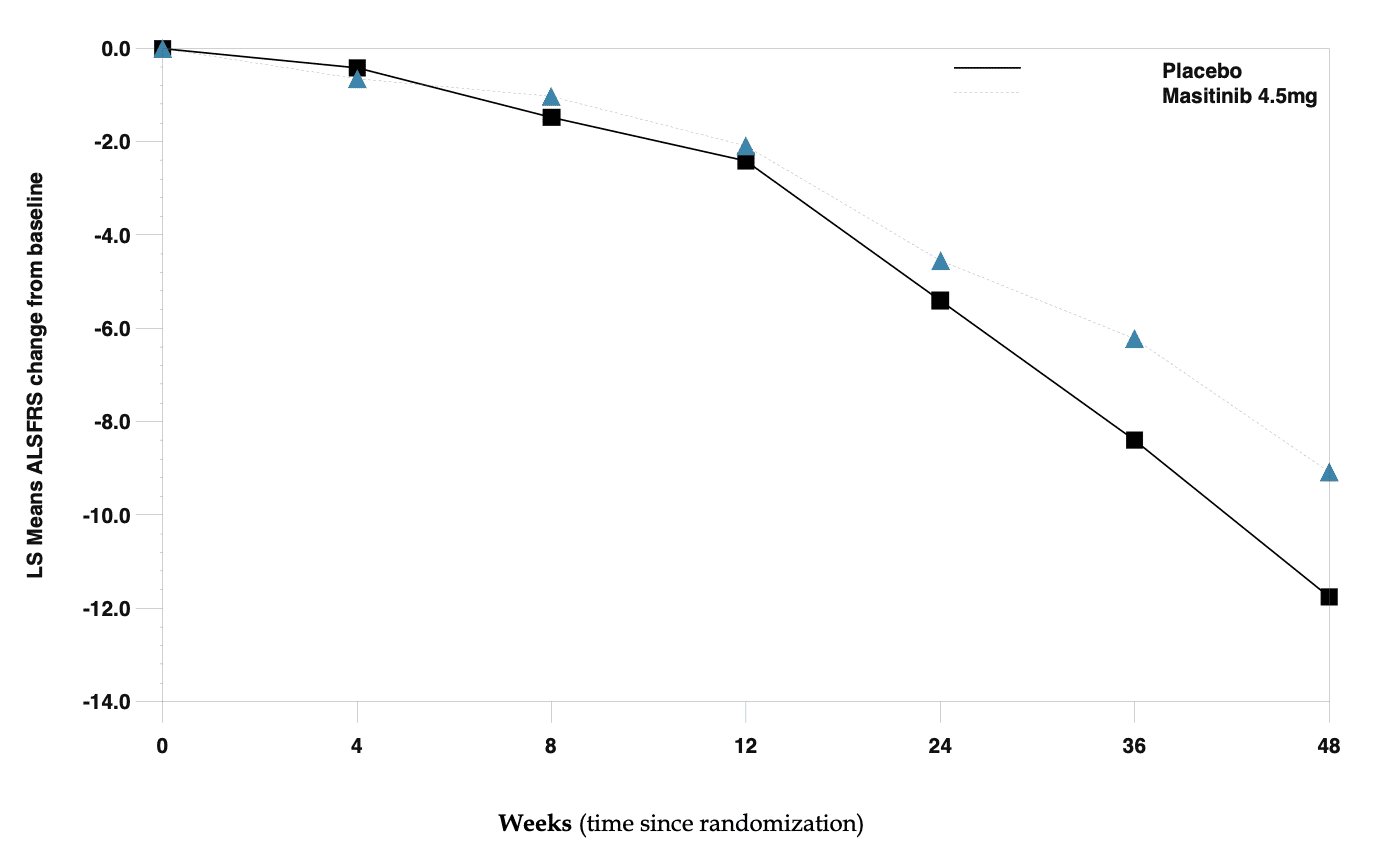
The results of the study have been published in the journal Amyotrophic Lateral Sclerosis & Frontotemporal Degeneration (ALSFTD) and represent the first positive phase 3 trial of a tyrosine kinase inhibitor in ALS.
A survival analysis followed all patients originally randomized in study AB10015 for an average duration of 75 months from the date of diagnosis. In ALS patients with mild or moderate disease severity at baseline, it was seen that treatment with 4.5 mg/kg/day masitinib as an add-on to standard riluzole prolonged survival by 25 months relative to those treated with riluzole alone, with a 44% reduced risk of death. Patients with mild or moderate ALS correspond closely to the patient population enrolled in study AB19001. This new survival data has been published in the peer-reviewed journal Therapeutic Advances in Neurological Disorders.
Finally, upon further analysis, it appeared that there is a clear increased benefit in the subgroup referred to as “ALS prior to any complete loss of function” (i.e. excluding patients with an ALSFRS-R score of 0 on any of the 12 items of the scale). Indeed, a +12-month survival benefit (p = 0.0192) was observed in this subgroup, a result from an analysis published as a preprint and not yet peer-reviewed.
Confirmatory Phase 3 study with masitinib in Amyotrophic Lateral Sclerosis
AB Science intends to initiate a confirmatory Phase 3 study evaluating masitinib in amyotrophic lateral sclerosis. This study will aim to confirm the efficacy and tolerability of masitinib (at a dose of 4.5 mg/kg/day in combination with riluzole) versus riluzole plus placebo after 48 weeks of treatment in amyotrophic lateral sclerosis.
The study is expected to include 408 patients with ALS (1:1 randomization), with a normal rate of disease progression (i.e. decline in functional score of less than 1.1 points per month) and no complete loss of function yet (i.e. a score of at least 1 on each of the 12 ALSFRS-R items). US patients receiving edaravone will also be eligible to participate in the study, with use of this medication included as a stratification factor.
This design has been validated during interactions with European health authorities, in particular with regard to the criteria defining the optimal population selected for the confirmatory study.